2026 Top Trends in 3D Printing Technology and Applications?
In recent years, 3D printing has emerged as a transformative technology. It offers endless possibilities across multiple industries, from healthcare to aerospace. The ability to create complex structures quickly and efficiently is revolutionizing production methods.
As we look towards 2026, understanding the top trends in 3D printing becomes crucial. New materials and techniques are enhancing functionality and sustainability. However, challenges still remain. The industry faces issues like material limitations and print speed. Finding reliable solutions requires collaboration and innovation.
Research indicates that businesses incorporating 3D printing see measurable benefits. Yet, some companies struggle to integrate this technology effectively. This uncertainty can hinder potential growth. Exploring future trends is vital for those wanting to stay competitive in the evolving landscape of 3D printing.
Emerging Technologies Reshaping 3D Printing in 2026
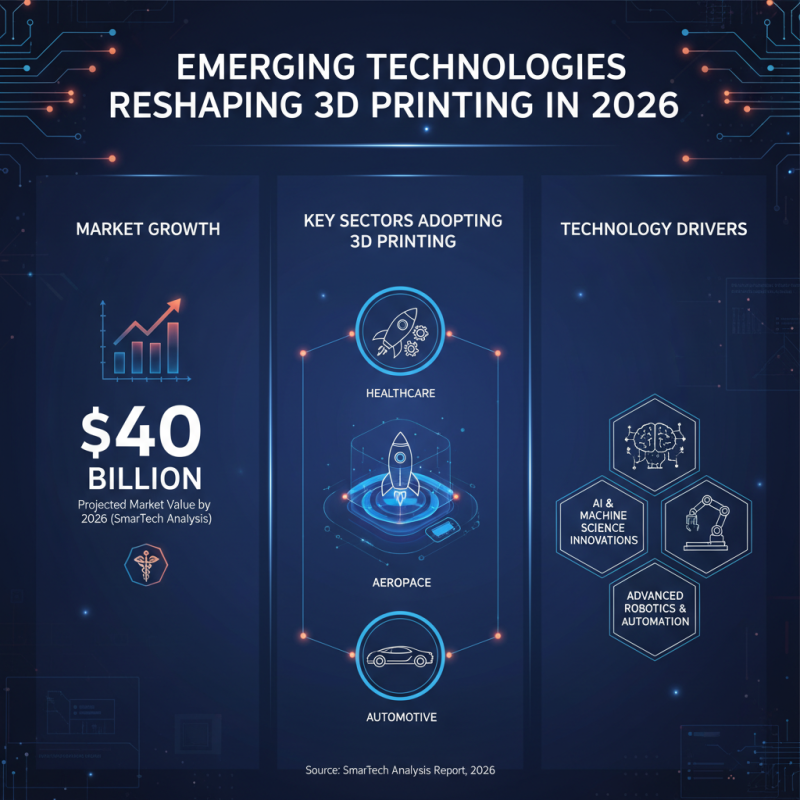
In 2026, 3D printing technology is experiencing revolutionary changes. Emerging technologies are significantly reshaping this industry. According to a recent report by SmarTech Analysis, the 3D printing market is projected to reach $40 billion by 2026. This growth highlights the increasing adoption across various sectors, including healthcare, aerospace, and automotive.
One notable trend is the integration of artificial intelligence in 3D printing systems. AI enhances the design processes, optimizing them for efficiency. This is vital for reducing material waste. Furthermore, machine learning algorithms can predict failures, ensuring higher precision in production. A study from Wohlers Associates indicates that 48% of companies are adopting AI to refine their 3D printing workflows.
Sustainability is another focus area. Biodegradable materials are becoming more common in 3D printing. These materials help in reducing environmental impact. However, challenges remain. The transition from traditional to sustainable materials requires a mindset shift in many organizations. There’s still a reliance on conventional plastics in some sectors. Continuous education and awareness are needed to drive this change. As 3D printing evolves, it is crucial to address these issues for a truly sustainable future.
Advancements in Materials for 3D Printing Applications
The landscape of 3D printing technology is evolving rapidly. Advancements in materials significantly enhance applications across various sectors. New materials, including bio-based options and advanced composites, broaden the scope of what can be created. These innovations allow for stronger, lighter, and more versatile products.
In healthcare, for example, biocompatible materials enable the production of custom implants and prosthetics. The ability to tailor these items enhances patient outcomes. Similarly, in aerospace, lightweight materials reduce fuel consumption and emissions. Yet, the integration of these advanced materials also raises challenges. Ensuring consistent quality remains a key concern.
The testing and validation of new materials need rigorous standards. A misstep in material choice could lead to catastrophic failures. Continuous research is vital to mitigate these risks. The industry must balance innovation with safety. It is crucial to refine processes and enhance material properties while addressing any shortcomings in current methodologies.
Influence of AI and Machine Learning on 3D Printing Processes
The intersection of AI and machine learning with 3D printing is reshaping the industry. AI algorithms can optimize design processes. They analyze countless iterations quickly, finding solutions that humans might overlook. This capability enhances product quality and reduces material waste. Machine learning also helps in predictive maintenance, extending printer life.
However, the impact of AI isn't without challenges. Data quality directly influences outcomes. Inaccurate data can lead to flawed designs or inefficient processes. It’s crucial to keep refining the data used for training algorithms. Balancing innovation with risk management remains a key concern.
In terms of applications, healthcare stands out. AI-driven 3D printing can create customized implants tailored to individual patient needs. This personalized approach holds great promise but demands rigorous validation. The integration of AI offers exciting potential, yet it also necessitates careful scrutiny of ethical considerations and accuracy.
2026 Top Trends in 3D Printing Technology and Applications
This bar chart illustrates the projected growth rates of different 3D printing applications and technologies influenced by AI and Machine Learning in 2026.
Sustainability Trends in 3D Printing for Future Applications
As the world increasingly shifts towards sustainability,
3D printing technology is stepping up to the plate.
This innovation allows for the use of recycled materials, reducing waste significantly.
By utilizing biodegradable filaments, industries can help lower their carbon footprints.
The shift towards sustainable materials in 3D printing encourages companies to rethink their production methods.
It’s a crucial step for the future.
However, the journey is not without challenges. Sourcing sustainable materials can be tricky.
Furthermore, the quality of these materials often needs improvement.
Manufacturers must invest in research to enhance the performance of eco-friendly options.
Collaboration among industry players is essential. It can drive advancements while promoting best practices for sustainability.
Designers and engineers are now focusing on creating products that prioritize sustainability from the initial concept.
In this approach, 3D printing becomes a tool for circular economy strategies.
It encourages on-demand production, which minimizes excess inventory.
While the path forward is promising, many questions remain unanswered.
Balancing innovation with environmental impact will require continuous effort and reflection from all stakeholders involved.
Industry-Specific Innovations in 3D Printing Technology
The landscape of 3D printing is evolving rapidly, transforming various industries. In healthcare, customized implants and prosthetics are becoming mainstream. A recent report from a leading research firm indicates that the medical 3D printing market is projected to reach $2.4 billion by 2026, reflecting a compound annual growth rate of over 19%. This showcases a growing reliance on tailored solutions that address individual patient needs effectively.
In the aerospace and automotive sectors, 3D printing is achieving significant milestones. Lightweight parts produced through additive manufacturing help reduce fuel consumption. Studies reveal that using 3D printed components can lead to weight reductions of up to 50% in certain designs. However, challenges such as material limitations and manufacturing consistency remain prevalent. Industry leaders must tackle these issues to fully realize the potential of 3D printing in optimizing production processes.
Sustainability is another trend worth noting. With increased focus on eco-friendly practices, 3D printing offers opportunities for waste reduction. Reports suggest that approximately 30% less material is wasted compared to traditional methods. Despite the promise, many companies are still figuring out the balance between sustainability and cost-effectiveness. As 3D printing technology continues to advance, industry-specific innovations will critically shape its trajectory.