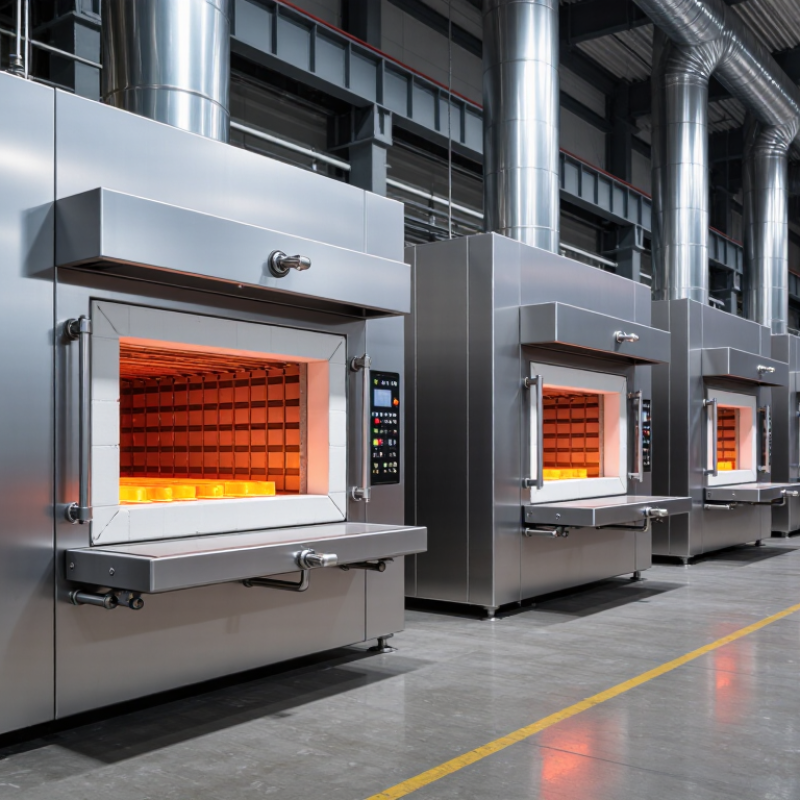
China has become a significant manufacturing base for industrial heat-treatment equipment, including the Hardening Oven. Global buyers now look beyond purchase price. They examine temperature uniformity, chamber construction, control systems, energy use, documentation, and after-sales support.
Market evidence supports this attention. Grand View Research has identified industrial ovens as a growing global equipment market, driven by automotive, aerospace, electronics, and metal-processing demand. The International Energy Agency also continues to highlight industrial heat as a major energy-consumption area, making efficiency and heat recovery increasingly important. These trends make oven selection more technical than it first appears.
Performance matters.
A reliable Hardening Oven should maintain stable temperatures across the working zone, even when loaded with dense steel parts. Buyers may also inspect furnace insulation, quenching compatibility, PLC controls, alarm records, calibration procedures, and spare-parts availability. ISO 9001 certification can indicate process discipline, but it does not automatically prove thermal performance. Independent testing remains essential.
This guide introduces China’s top 10 hardening oven manufacturers for global buyers. The selection considers manufacturing experience, product range, export capability, engineering support, customization, and documented quality practices. Information from company records, industry directories, technical materials, and relevant market reports can support the comparison. Still, no ranking is completely objective. Factory audits, reference checks, sample testing, and contract review should shape the final decision. A polished website is not enough. Neither is the lowest quotation. In some cases, published specifications may lack test conditions or tolerances. That gap deserves attention before investment.
A hardening oven is an industrial furnace used to increase the strength and wear resistance of metal parts. It heats steel to a controlled temperature, often above its critical transformation range. The exact temperature depends on the alloy, component size, and required hardness. Heat must reach the core, not only the surface. That detail matters.
Inside the chamber, electric heating elements raise the temperature evenly. Thermocouples monitor several zones, while a controller adjusts power automatically. Some ovens use protective gas to reduce oxidation and surface scaling.
After soaking, operators transfer the parts to a quenching medium, such as oil, water, or polymer solution. The rapid cooling changes the metal’s internal structure and produces hardness. Transfer time is critical. A short delay can affect results.
Hardening is rarely a single-step operation. Many parts require tempering afterward to reduce brittleness and relieve internal stress. Experienced technicians check furnace uniformity, calibration records, loading patterns, and quench temperature before production. A crowded basket may create uneven heating. Thin parts can distort. Large components may need slower heating rates. These issues are easy to underestimate. Even a well-designed oven cannot correct poor loading or an unsuitable process recipe.
China Top 10 Hardening Oven Manufacturers for Global Buyers
Key Criteria for Evaluating Chinese Hardening Oven Manufacturers
A reliable hardening oven begins with temperature uniformity, not a polished brochure. The U.S. Department of Energy reports that process heating uses about 51% of industrial energy consumption. This makes insulation, burner efficiency, heating control, and heat recovery important purchasing criteria. Ask for temperature uniformity survey results, not only the rated maximum temperature. A chamber showing 850°C may still produce uneven hardness across a steel batch.
Look for traceable testing records. Thermocouple calibration, controller accuracy, airflow mapping, and recorder data should be available before shipment. ISO 13577-2 provides safety guidance for industrial furnaces and associated combustion systems. A serious manufacturer should explain how its design addresses these requirements. It should also provide welding records, material certificates, spare-parts lists, and remote troubleshooting procedures. Small details matter.
Energy performance needs real evidence. The International Energy Agency identifies industrial energy efficiency as a major pathway for reducing manufacturing emissions. Request measured fuel or electricity consumption under a defined load. Empty-chamber figures are less useful. Check the factory’s export experience, installation supervision, and response time for technical faults. Factory visits can reveal testing discipline, but they are not perfect. Some buyers still rely too heavily on certificates. Practical batch trials and independent inspection may expose weaknesses earlier.
Anonymous comparison framework for screening Chinese hardening-oven suppliers. Supplier-specific technical figures, certifications, references, and commercial terms should be verified through documentation, factory audits, and sample testing before purchase.
| Rank | Anonymous Supplier Profile | Recommended Temperature Range to Verify | Useful Work-Zone Information | Atmosphere and Process Capability | Temperature Uniformity Evidence | Control and Data Requirements | Safety and Compliance Documents | Global Buyer Verification Priority | Evidence to Request Before RFQ Approval |
|---|---|---|---|---|---|---|---|---|---|
| 1 | Supplier Slot 01 | Confirm whether the design covers the required hardening range, commonly up to approximately 1,000–1,200 °C for many steel heat-treatment applications. | Confirm internal dimensions, usable load, maximum batch weight, door opening, and loading method. | Verify air circulation, inert-gas capability, quench compatibility, and suitability for the buyer’s material grade. | Request a temperature-uniformity survey at operating temperature and representative load. | Confirm programmable recipes, over-temperature protection, alarm history, data export, and remote diagnostics. | High: request electrical drawings, risk assessment, emergency-stop details, and applicable conformity documents. | Documentation first | Technical datasheet, GA drawing, control-system description, test protocol, warranty terms, and reference list. |
| 2 | Supplier Slot 02 | Check rated temperature, continuous operating temperature, heat-up time, and allowable empty-versus-loaded operating conditions. | Compare chamber volume with actual part envelope and required spacing for uniform airflow. | Verify whether the oven is intended for air hardening, neutral atmosphere, protective atmosphere, or another process. | Ask for measurement-point layout, acceptance limits, calibration records, and survey frequency. | Confirm PLC or controller architecture, password levels, recipe management, and backup procedures. | High: verify guarding, insulation materials, electrical protection, and local installation requirements. | Process fit | Process flow, sample thermal profile, calibration certificates, commissioning plan, and operator training scope. |
| 3 | Supplier Slot 03 | Request independent confirmation of the maximum rated temperature and the recommended production setpoint. | Evaluate usable work zone rather than total chamber size; confirm payload and trolley or tray specifications. | Check oxygen-control requirements, atmosphere sealing, exhaust arrangement, and gas-consumption estimates. | Require uniformity results under conditions that represent the buyer’s production load. | Verify temperature recording, audit-trail capability, recipe access control, and network compatibility. | Medium: review component certificates and compliance with the destination market’s electrical rules. | Audit required | Factory acceptance-test format, software screenshots, spare-parts list, maintenance schedule, and audit responses. |
| 4 | Supplier Slot 04 | Confirm heating-element rating, insulation temperature rating, and expected temperature stability during production. | Check floor loading, installation footprint, service clearance, and maximum batch dimensions. | Verify whether atmosphere control is integrated or supplied as an optional package. | Ask for uniformity tolerance, stabilization time, sensor type, and calibration method. | Confirm alarm management, interlocks, power-loss recovery, and data retention period. | High: verify emergency controls, over-temperature cutouts, and safe gas-exhaust design where applicable. | Safety review | Risk assessment, wiring diagram, safety-component list, installation manual, and preventive-maintenance plan. |
| 5 | Supplier Slot 05 | Compare the guaranteed operating range with the buyer’s required material-treatment recipe and cycle profile. | Confirm actual usable capacity after fixtures, baskets, racks, or protective liners are installed. | Request process-atmosphere limits, sealing details, gas inlet and outlet specifications, and purge sequence. | Require test data showing repeatability across multiple zones and representative production cycles. | Verify recipe storage, batch identification, user permissions, USB or network export, and reporting format. | Medium: request evidence of quality-control procedures for sensors, heating elements, and fabricated parts. | Repeatability | Sample cycle report, quality plan, inspection checklist, spare-parts availability, and service-response procedure. |
| 6 | Supplier Slot 06 | Verify rated temperature under continuous operation, not only the short-duration laboratory rating. | Review loading ergonomics, door design, lifting equipment, trolley alignment, and operator access. | Confirm fan arrangement, airflow direction, atmosphere uniformity, and suitability for the part geometry. | Request a documented uniformity survey with calibrated instruments and clear acceptance criteria. | Check HMI language options, remote support, user access levels, and controller replacement strategy. | High: confirm thermal insulation safety, moving-part protection, and electrical enclosure rating. | Usability check | Layout drawing, ergonomic assessment, operating instructions, training agenda, and acceptance-test checklist. |
| 7 | Supplier Slot 07 | Ask for heat-up performance at empty and loaded conditions, including ambient-temperature assumptions. | Confirm effective chamber volume, maximum product weight, fixture weight, and thermal mass assumptions. | Verify gas purity requirements, flow rates, leak-test method, and exhaust treatment where relevant. | Compare guaranteed uniformity with the buyer’s process specification and measurement standard. | Confirm event logging, data export, recipe revision control, and backup of configuration files. | Medium: request destination-country documentation and a clear division of installation responsibilities. | Performance test | Heat-up curve, energy estimate, atmosphere test record, software backup, and commissioning responsibilities. |
| 8 | Supplier Slot 08 | Confirm whether the oven can maintain the required setpoint without excessive cycling or overshoot. | Check chamber construction, access dimensions, loading fixtures, and future expansion requirements. | Verify compatibility with the selected hardening medium and any required preheating or tempering steps. | Request survey results before and after commissioning, including sensor calibration status. | Review control-loop tuning, alarm escalation, trend displays, and communication interfaces. | High: review fire prevention, over-temperature protection, interlocks, and emergency shutdown logic. | Risk control | Functional-safety description, alarm matrix, electrical test report, service manual, and recommended spares. |
| 9 | Supplier Slot 09 | Validate the operating range against the actual steel, aluminum, tool, or component treatment specification. | Confirm batch throughput, cycle capacity, fixture arrangement, and loading frequency assumptions. | Check atmosphere stability, sealing performance, purge logic, and compatibility with production ventilation. | Require production-representative mapping rather than an empty-chamber demonstration only. | Verify electronic records, user permissions, time synchronization, and data-access ownership. | Medium: check traceability of critical components and the supplier’s document-control process. | Traceability | Production references, traceability example, batch-record template, FAT/SAT plan, and support contacts. |
| 10 | Supplier Slot 10 | Request a written guarantee for maximum temperature, working temperature, stability, and expected service life of heating elements. | Assess installation route, shipping sections, foundation needs, utilities, and access for maintenance. | Confirm whether the supplier can integrate atmosphere, quench, cooling, or material-handling systems when required. | Define acceptance criteria before ordering and identify who pays for re-testing if results are not achieved. | Confirm software support period, cybersecurity responsibilities, replacement-controller policy, and data ownership. | High: verify warranty exclusions, spare-parts lead times, service coverage, and local compliance obligations. | Commercial due diligence | Final quotation, utility list, delivery schedule, warranty, service-level terms, packing method, and total-cost estimate. |
Note: The supplier slots are intentionally anonymous. The table presents verifiable buyer-evaluation criteria and typical engineering checkpoints rather than unverified claims about individual companies or brands.
China Top 10 Hardening Oven Manufacturers for Global Buyers
China’s top ten hardening oven manufacturers show different strengths, rather than one universal advantage. Some specialize in batch ovens for tool steel and automotive components. Others focus on continuous lines, vacuum systems, or customized production cells. Their practical strengths include temperature uniformity, programmable controls, insulation quality, and export support.
The International Energy Agency’s Energy Efficiency 2023 report states that industry uses about 37% of global final energy. This makes thermal efficiency a serious purchasing issue. A reliable oven should document heat-loss performance, temperature mapping, and cycle repeatability. Buyers should also review actual power consumption under load. Marketing claims can look impressive, but test records matter more. A perfect ranking is impossible. Export volume may hide weak service capacity.
Tips: Request a sample temperature-uniformity report. Check spare-part lead times. Confirm whether the control system supports your local voltage and safety requirements. Ask for references from factories using similar materials. The 2024 Industrial Furnaces Market research from Grand View Research also highlights rising demand for energy-efficient and automated systems. Therefore, buyers should compare lifetime operating costs, not only the purchase price. Some low-cost designs still consume more energy. That lesson is easy to miss.
When comparing the top ten hardening oven manufacturers, global buyers should examine product features beyond heating temperature. Useful details include chamber volume, operating range, heating uniformity, airflow design, insulation thickness, and cooling control. A well-designed oven reduces hot spots and supports repeatable hardness results. Digital records also help operators trace each batch. However, impressive specifications do not always reflect daily performance.
Quality standards deserve equal attention. Ask for temperature uniformity survey reports, sensor calibration records, and documented inspection procedures. ISO 9001 certification can indicate controlled processes, while regional safety certifications may support smoother installation. For demanding aerospace or automotive work, buyers may also request standards aligned with AMS2750 or equivalent requirements. Production capacity should be judged through furnace size, monthly output, testing equipment, and spare-part availability. Factory visits provide useful evidence, though they cannot reveal every future service problem.
Tips: Request sample test data from a comparable workload. Check whether quoted capacity means one shift or continuous operation. Confirm lead times in writing. A low price may conceal weaker insulation or limited technical support. No comparison is perfect. Buyer experience still matters, especially when material thickness, loading patterns, and local power conditions differ.
Selecting a Chinese hardening oven supplier requires more than comparing prices. Start by matching the oven design with your material, batch size, target hardness, and production rhythm. Ask for chamber temperature uniformity data, heating rates, cooling performance, and control-system details. A reliable supplier should explain these figures clearly, not hide behind general claims. Request drawings, electrical specifications, and recent inspection records before signing a contract.
Visit the factory, if practical. Check welding quality, insulation thickness, thermocouple placement, and control-panel labeling. A clean assembly area often reflects stronger process discipline, although appearances can mislead. Ask whether critical components are tested before installation. Confirm the supplier’s export experience, installation support, spare-parts availability, and response time. You should also request a factory acceptance test using samples similar to your own parts. Small test differences matter. A supplier may offer excellent equipment but weak documentation, creating trouble during commissioning.
Tips: Compare at least three technical proposals, not only three quotations. Define acceptance standards in writing. Include temperature deviation limits, delivery milestones, warranty terms, and training requirements. Check whether software backups and electrical diagrams are included. Do not accept vague promises about energy savings. Ask for measured data. One overlooked issue is local service coverage; remote troubleshooting may be slow across time zones. A lower price can become expensive after repeated delays. Leave room for honest review, because your first specification may not be perfect.