Top Wooden Window Frame Suppliers in China

Choosing a wooden window supplier is not only a price decision. Frame design, timber selection, moisture control, and finishing all affect how a window performs after installation. Wooden Window Frames can bring warmth and strong insulation potential, but performance depends on the complete window system—not appearance alone.

The International Energy Agency’s 2023 buildings-sector tracking report estimates that building operations account for about 30% of global final energy consumption and 26% of energy-related emissions. These figures do not measure window performance directly. They do, however, explain why buyers should examine verified thermal data rather than rely on broad efficiency claims. Ask suppliers for test reports, declared U-values, timber species, moisture specifications, and details about coatings and hardware. Small details matter.

China has a broad manufacturing base, yet supplier capabilities vary. A polished sample cannot show how consistently a factory controls moisture or finishes a large production run. This guide to Top Wooden Window Frame Suppliers in China focuses on product evidence, manufacturing experience, quality systems, customization, and communication. It also encourages buyers to check references and request current documentation before placing an order. No shortlist can replace due diligence. Even a well-presented supplier may not be the right fit for every climate, project, or installation method.

Top Wooden Window Frame Suppliers in China

Wooden Window Frames in China: Timber Species, Components, and Manufacturing

Top Wooden Window Frame Suppliers in China

Wooden Window Frames in China: Timber Species, Components, and Manufacturing

In China, frames commonly use pine, fir, larch, and oak, selected for cost, grain, and exposure. Softwoods machine readily; denser hardwoods can hold crisp profiles but need careful drying. Species names alone tell little. Ask for the botanical name, source region, kiln-drying records, and shipment moisture readings. FAO’s Global Forest Resources Assessment 2020 estimates that forests cover 4.06 billion hectares worldwide, making documented timber sourcing an important part of supplier checks.

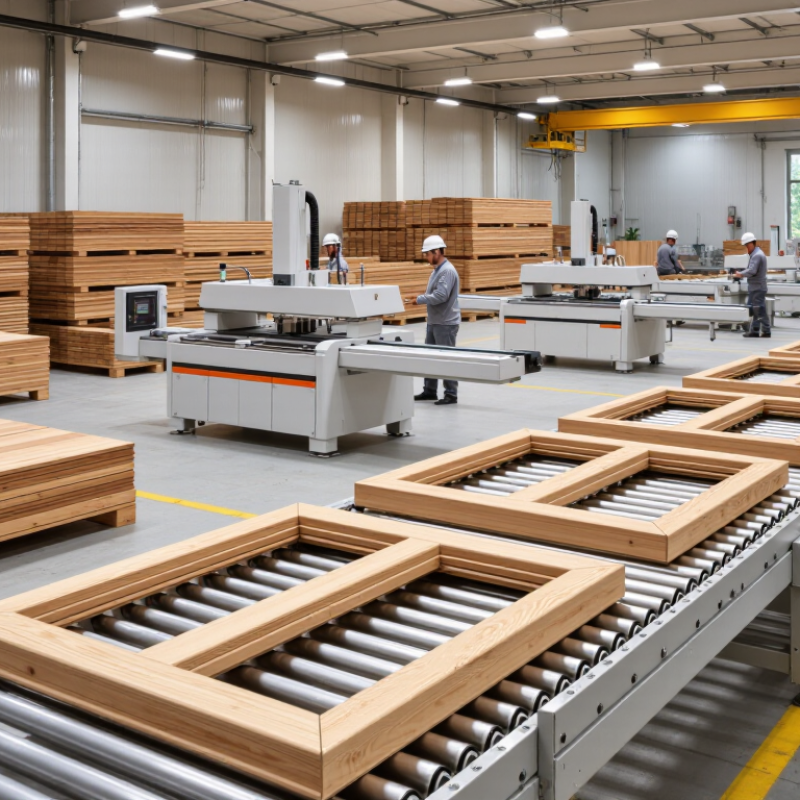
A sound frame is a system: stiles and rails, corner joints, glazing rebates, weather seals, drainage paths, and protective finishes. Finger-jointed or laminated stock can remove some defects, but adhesive control still matters. CNC machining improves repeatability; coating coverage and assembly tolerances still need inspection. The USDA Forest Products Laboratory’s Wood Handbook (FPL-GTR-282, 2021) places the fiber saturation point near 30% moisture content for many woods. Below that point, moisture changes can affect dimensions. Kiln schedules and acclimatization matter. One awkward truth: a perfect sample can hide uneven batch drying.

Tip: Request moisture readings from several frame sections. Check joint photos, coating records, and air- and water-resistance test reports for the same opening size.

Top Wooden Window Frame Suppliers in China - Wooden Window Frames in China: Timber Species, Components, and Manufacturing
Category Material or Component Typical Details Manufacturing or Sourcing Considerations
Timber species Pine Softwood commonly used for painted and stained window frames. Indicative density is approximately 450–550 kg/m³ at about 12% moisture content; values vary by species and grade. Check the specified pine species, grading, knot limits, moisture content, and whether frame members are solid or laminated.
Timber species Larch Softwood with a comparatively dense structure; indicative density is approximately 550–650 kg/m³ at about 12% moisture content. Natural durability varies with species and heartwood content. Confirm the timber grade and the intended exterior coating system; density and durability figures are indicative rather than guarantees of service life.
Timber species Oak Hardwood with a prominent grain; indicative density is approximately 600–750 kg/m³ at about 12% moisture content, depending on species and origin. Check species identification, drying quality, movement allowances, and compatibility with the selected finish and hardware.
Timber species Eucalyptus Hardwood group with substantial variation between species; indicative density can be approximately 550–750 kg/m³ at about 12% moisture content. Request the exact species and grade. Confirm drying, stability, and suitability for the specified frame section and exposure conditions.
Frame component Stiles and rails Vertical and horizontal members forming the main sash or frame structure. Review section dimensions, corner-joint construction, timber continuity, and any laminated or finger-jointed construction shown in the specification.
Frame component Mullions and transoms Intermediate vertical and horizontal members that divide a frame or glazing area. Confirm the layout, member sizes, and how the divisions affect glass sizes and the overall window configuration.
Frame component Glazing beads and rebates Beads retain glazing; rebates are the prepared sections that receive the glass or insulating glass unit. Check that rebate dimensions suit the specified glazing build-up and that the glazing detail allows appropriate sealing and drainage.
Frame component Sill and drip detail The sill helps shed water away from the lower frame; a drip detail can reduce water tracking back underneath. Review sill slope, end-grain protection, and connections to the surrounding wall and drainage details.
Sealing and hardware Weather seals, gaskets, and hardware Compression seals and gaskets help limit air and water passage; hinges, handles, and locking parts enable operation and closure. Confirm compatibility among seals, sash design, hardware, and the specified opening type. Request test evidence when performance ratings are required.
Manufacturing Timber drying and conditioning Moisture content is controlled before machining and assembly. A range of about 8–12% is commonly specified for joinery, but the appropriate target depends on the service climate and project requirements. Ask for the project moisture-content specification and documented checks; avoid treating one target range as suitable for every climate.
Manufacturing Machining and corner joints Profiles and joinery may be produced using CNC or conventional machining. Corner joints can include mortise-and-tenon or other engineered joints. Check drawings, tolerances, joint fit, adhesive specification where applicable, and sample workmanship before production approval.
Manufacturing Laminated or finger-jointed stock Engineered timber sections are assembled from smaller pieces and may be used to form longer or more consistent frame members. Request details of the timber grade, adhesive, joint locations, and suitability of the finished member for the intended exposure.
Finishing and quality control Coating, sealing, and inspection Exterior coatings protect exposed timber surfaces; end-grain sealing and careful coverage of joints are important parts of the finishing process. Specify the coating system, colour, application process, and inspection criteria. Confirm that glass, seals, drainage paths, and hardware are checked before packing.
Note: Density figures are approximate reference ranges, not product guarantees. Timber properties vary by species, origin, grade, and moisture content. For supplier comparisons, request project-specific drawings, material specifications, samples, and relevant test documentation.

China’s Supplier Landscape: Product Types, Customization, and Export Markets

China’s wooden-window suppliers typically offer solid-wood, finger-jointed, and laminated frames. Some also make wood-aluminium designs, with timber interiors and weather-resistant exterior cladding.

Common customization includes species, stain, glazing dimensions, opening style, and hardware preparation. Ask for moisture-content readings and corner-joint samples; a polished catalogue can hide uneven finishing.

Material claims deserve careful checking.

The FAO’s Global Forest Resources Assessment 2020 estimates China’s forest area at about 220 million hectares. The National Forestry and Grassland Administration reported forest coverage of 24.02% in 2023.

Neither figure proves that a supplier’s timber is locally sourced or traceable. Request species details, sourcing documentation, and finish samples before comparing quotations.

Small details matter.

Export orders need more than a lower unit price.

Buyers should confirm packaging, frame tolerances, glazing compatibility, and performance under the destination’s temperature and humidity changes.

UN Comtrade classifies wooden windows under HS 441810, a useful code for reviewing trade flows; it does not reveal supplier quality or project suitability.

Export markets vary, so request test documentation relevant to the intended market. One limitation: specifications can look complete on paper, yet installation conditions may still change the result.

Thermal Performance: China’s GB/T 8484-2020 10-Grade Rating System

Top Wooden Window Frame Suppliers in China

For wooden windows, thermal performance should be checked against the complete window, not the glass alone. China’s GB/T 8484-2020 grades thermal insulation from 1 to 10, with grade 10 representing the lowest heat-transfer coefficient. Under the standard’s scale, grade 10 is at or below 1.0 W/(m²·K), while grade 1 is above 5.0 W/(m²·K). Lower heat transfer generally means less heat passing through the tested assembly. That matters. Ask suppliers for a test report showing the window configuration, dimensions, and test conditions; changing the glazing or frame design can change the result.

The wider energy context is significant. UNEP and the Global Alliance for Buildings and Construction reported that buildings and construction accounted for 34% of global energy demand in 2022. Their 2023 Global Status Report also attributed 37% of energy- and process-related carbon emissions to the sector.

A higher window grade can support better insulation, but it does not guarantee the same performance in every building. Installation gaps, seals, and frame joints matter. This is where comparisons get messy. A laboratory figure may not reflect a poorly fitted frame, and wood species alone cannot establish a grade. Request comparable test data, then check how the proposed window will be installed.

Air Permeability: How EN 12207 Classifies Windows from Class 1 to 4

For wooden window suppliers in China, air permeability should be assessed on the complete window, not the timber frame alone. EN 12207:2016 classifies windows using measured leakage under pressure, with testing described in EN 1026. Its reference limits at 100 Pa are 50, 27, 9, and 3 m³/(h·m²) for Classes 1 through 4. Limits per metre of opening joint are 12.5, 6.75, 2.25, and 0.75 m³/(h·m). Lower leakage means a tighter classification. Class 1 is tested up to 150 Pa; Class 2 up to 300 Pa; Classes 3 and 4 up to 600 Pa.

The numbers are useful. So is the test setup. A supplier’s report should identify the tested window dimensions, opening type, seals, and hardware; results from one configuration do not automatically apply to another.

On timber windows, inspect corner joints and compression seals, where small gaps can undermine an otherwise careful build. Wood is not automatically airtight, and that assumption deserves checking.

Ask for the laboratory test report and confirm its classification against EN 12207, rather than relying only on a general product description.

Real installation quality still matters; even a high-class tested unit can leak if the frame is poorly fitted.

Comparing Top Chinese Suppliers by Testing, Certifications, and Production Capacity

Top Wooden Window Frame Suppliers in China
Comparing Top Chinese Suppliers by Testing, Certifications, and Production Capacity

When comparing Chinese wooden window frame suppliers, inspect more than a smooth showroom sample. Ask for test reports covering the specific frame design, wood species, glazing, and hardware you plan to order. Check report dates and testing scope; a certificate for one product may not cover another. Numbers matter. Where possible, request test data from an independent laboratory and confirm that the listed standards match your project requirements.

Certifications can indicate documented quality or environmental controls, but they do not guarantee consistent production. Review the issuing body, validity period, and covered factory or product range. Then compare production capacity using practical details: monthly output, kiln-drying controls, moisture checks, inspection records, and lead times during peak seasons. A large stated capacity is less useful if the supplier cannot explain how it maintains wood moisture or handles defects. A polished catalog can still leave gaps; ask for recent inspection records and clear answers about rejected units.

Tips: Request a small trial order before committing to a large shipment. Compare frame dimensions, joint fit, finish, and packaging against your written specification. Keep a record of unanswered questions, too.

Top Wooden Window Frame Suppliers in China: What to Verify

Standardized performance-class ladders can help buyers compare test reports. The chart shows the number of numbered classes in three European window-performance classifications—not supplier scores or a ranking.

Air permeability, watertightness, and wind resistance are classified under EN 12207, EN 12208, and EN 12210, respectively. Class counts are not directly comparable measures of performance. For supplier comparisons, request product-specific test reports, verify relevant certifications, and confirm production capacity with documented evidence.

Top