What Is 3D Printing Material and Which Type Is Best?

Choosing the right 3d printing materials can determine whether a part succeeds or fails. The choice affects strength, appearance, flexibility, heat resistance, cost, and printing difficulty. A glossy spool may look attractive, but its performance depends on the object’s real working conditions.

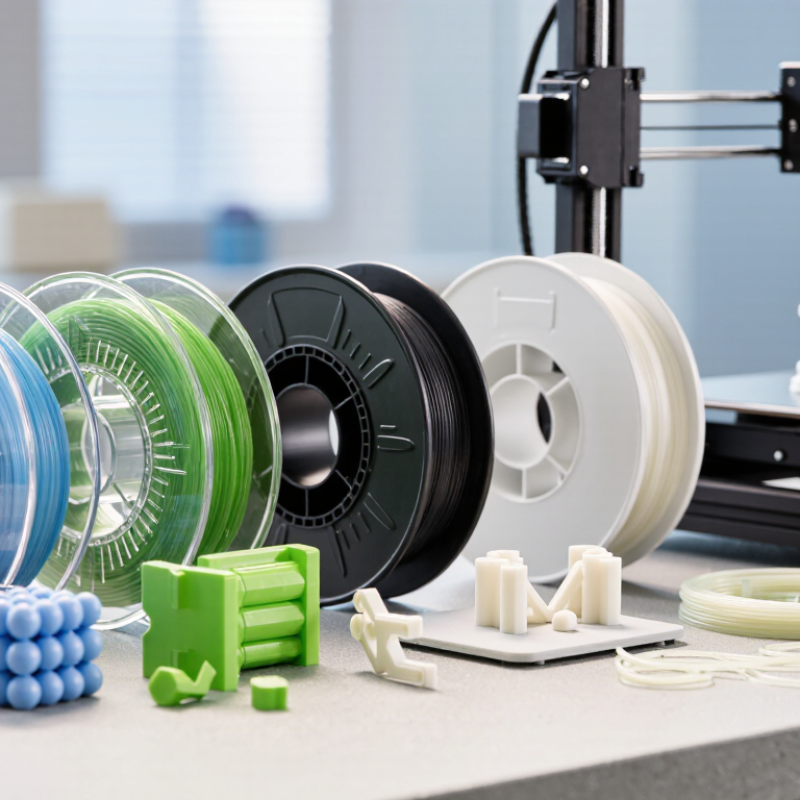
PLA remains a practical starting point for prototypes, models, classroom projects, and decorative parts. It prints at moderate temperatures and usually produces sharp details with limited warping. PETG offers better impact resistance and moisture tolerance, making it useful for brackets, containers, and workshop fixtures. ABS and ASA can handle higher temperatures, but they often need an enclosed printer, controlled cooling, and good ventilation. Nylon is tougher and more flexible, although it absorbs moisture quickly and demands careful drying.

There is no perfect material. Not even close. Experienced users compare manufacturer data with small, controlled test prints. A simple calibration piece can reveal layer adhesion, stringing, brittleness, and dimensional errors before valuable filament is wasted. Material datasheets provide useful guidance, but actual results vary with nozzle size, print speed, humidity, and machine design. That variation matters.

This guide examines common 3D printing materials through practical performance, technical properties, safety considerations, and typical applications. It also questions popular assumptions, because “strongest” does not always mean “best.” A brittle part can fail suddenly, while a slightly flexible material may survive daily use. The most reliable decision matches the material to the load, environment, printer, and user’s skill level.

What Is 3D Printing Material and Which Type Is Best?

What 3D Printing Material Means and Why It Matters

What Is 3D Printing Material and Which Type Is Best?

What 3D Printing Material Means and Why It Matters

3D printing material is the substance formed into a physical object layer by layer. It may arrive as plastic filament, liquid resin, metal powder, or fine pellets. Each form needs different equipment, temperatures, and handling methods. Material means more than color. It controls strength, flexibility, surface texture, heat resistance, and print accuracy.

In practical use, common plastic filament suits many household prototypes and functional parts. Some types are easy to print but soften near heat. Others resist impact better, yet they may warp during cooling. Liquid resin can capture tiny text and sharp edges. However, it usually requires careful washing and controlled curing. Metal powder supports demanding engineering work, but it needs specialized machines and strict process controls.

The best choice depends on the object, not popularity. I check the technical data sheet, expected load, operating temperature, and indoor or outdoor use. I also consider moisture, because damp filament can create bubbles and weak layers. A small test print often reveals problems before a large job wastes hours. I have sometimes chosen a material for strength and ignored its warping behavior. That mistake produced a cracked base and several failed prints. Material selection is partly technical judgment and partly honest testing. There is no universal winner.

How 3D Printing Materials Are Classified

3D printing material is more than a choice between plastic and metal. It is classified by composition, physical behavior, manufacturing process, and intended performance. Common families include polymers, metals, ceramics, and composite materials. Each family reacts differently to heat, moisture, pressure, and chemical exposure. A polymer part may bend before breaking, while a ceramic part can resist heat but crack suddenly.

The material’s physical form also matters. Filament is melted through a heated nozzle, liquid resin is cured with controlled light, and powder is fused or bound layer by layer. These forms are not interchangeable. Filament needs steady feeding and accurate temperature control. Resin requires careful exposure settings and thorough washing. Powder-based processes demand controlled handling and suitable ventilation. Small changes can leave rough surfaces, weak layers, or hidden voids.

Classification by performance is useful during material selection. Some materials are valued for flexibility, some for stiffness, heat resistance, low weight, or electrical insulation. In practical testing, a sample can look strong but fail around a screw hole. That mistake is easy to make. I now compare tensile strength, impact behavior, moisture absorption, and long-term temperature resistance before choosing a material. Manufacturer data helps, but real parts may perform differently because print direction, cooling, and layer bonding affect the result.

Key Properties Used to Compare Printing Materials

What Is 3D Printing Material and Which Type Is Best?

The best 3D printing material depends on the part’s working conditions, not its appearance. Key properties include tensile strength, elongation, impact resistance, heat resistance, moisture absorption, and dimensional stability. A rigid material may hold a load well, yet crack after repeated impacts. A flexible material can absorb shocks, but it may deform under constant pressure.

The 2024 Wohlers Report estimated the global additive manufacturing industry at 20.035 billion dollars in 2023. This growth has increased demand for materials with predictable performance. For comparison, engineers should examine standardized test data, including tensile strength and heat-deflection temperature under ISO or ASTM methods. Test direction also matters. Printed layers often create weaker bonding between layers than across them. That detail is easy to overlook.

Material choice should match the actual environment. Moisture-sensitive polymers may swell during storage. High-temperature polymers may require controlled printing conditions and careful cooling. Powder-based materials can offer strong, complex parts, but surface finish and post-processing need evaluation. Resin systems may capture fine details, although some parts become brittle over time.

Cost is not the only variable. Waste rate, drying requirements, print failure, and post-processing can change the real expense. A material that looks ideal on a datasheet may perform poorly in a humid workshop. Small practical tests remain valuable. Data helps, but conditions expose weaknesses.

What Is 3D Printing Material and Which Type Is Best? - Key Properties Used to Compare Printing Materials

Material Typical 3D Printing Process Typical Glass Transition or Softening Point Approximate Tensile Strength Flexibility Moisture Sensitivity Heat Resistance Ease of Printing Durability and Impact Performance Best-Suited Applications
PLA
(Polylactic Acid)
Fused Deposition Modeling (FDM/FFF) Approximately 55–65°C glass transition temperature Approximately 40–65 MPa Low; rigid with limited elongation Low to moderate; should still be stored dry Low; parts can soften in warm environments ★★★★★
Excellent first material
Good stiffness and surface detail, but relatively brittle under impact Visual prototypes, models, fixtures, educational projects, and decorative parts
ABS
(Acrylonitrile Butadiene Styrene)
FDM/FFF Approximately 95–110°C glass transition temperature Approximately 30–50 MPa Moderate; tougher than PLA Low to moderate Moderate to high ★★★☆☆
Requires controlled conditions
Good impact resistance and better functional durability than PLA Automotive-style components, housings, enclosures, and functional prototypes
PETG
(Polyethylene Terephthalate Glycol-Modified)
FDM/FFF Approximately 75–85°C glass transition temperature Approximately 45–70 MPa Moderate; generally less brittle than PLA Moderate; drying is recommended for consistent quality Moderate ★★★★☆
Generally forgiving
Good layer adhesion, toughness, and chemical resistance Mechanical prototypes, containers, brackets, workshop parts, and outdoor-use components
Nylon / Polyamide (PA) FDM/FFF, selective laser sintering, and other powder-based processes Approximately 45–70°C glass transition temperature, depending on grade; melting temperatures are commonly around 180–260°C Approximately 45–80 MPa High; tough and wear-resistant High; absorbs moisture readily and must be dried carefully Moderate to high, depending on grade ★★★☆☆
Needs drying and process control
Excellent toughness, fatigue resistance, and abrasion resistance Gears, hinges, clips, brackets, fixtures, and durable functional parts
TPU
(Thermoplastic Polyurethane)
FDM/FFF and selective laser sintering Varies widely by formulation; commonly approximately −30 to 60°C glass transition range Approximately 20–50 MPa Very high; flexible and elastomeric Moderate; drying improves print consistency Low to moderate, depending on hardness grade ★★☆☆☆
Requires slow, controlled printing
Excellent impact, abrasion, and repeated-flex performance Seals, gaskets, protective covers, vibration dampers, wheels, and flexible wearables
Polycarbonate (PC) FDM/FFF Approximately 140–150°C glass transition temperature Approximately 55–75 MPa Moderate; strong and slightly ductile High; drying is important before printing High ★★☆☆☆
Requires high temperatures and controlled cooling
Very good impact strength and dimensional stability at elevated temperatures High-strength brackets, protective enclosures, machine components, and engineering prototypes
Photopolymer Resin Vat photopolymerization, including SLA, DLP, and MSLA Varies significantly by formulation; many standard resins soften at approximately 50–80°C Approximately 20–70 MPa, depending on resin type Ranges from brittle to flexible according to formulation Generally low after curing, but prolonged exposure can affect some formulations Low to moderate for standard resin; engineering resins can be higher ★★★★☆
High detail but requires washing and post-curing
Excellent fine detail and smooth surfaces; standard grades may be brittle or UV-sensitive Miniatures, dental and jewelry patterns, presentation models, and detailed prototypes
PEEK
(Polyether Ether Ketone)
High-temperature FDM/FFF and industrial powder or pellet-based processes Approximately 143°C glass transition temperature; melting temperature is approximately 343°C Approximately 80–100 MPa Moderate; strong, stiff, and wear-resistant Low to moderate compared with many hygroscopic engineering polymers Very high ★☆☆☆☆
Requires specialized equipment and thermal control
Excellent chemical, wear, fatigue, and high-temperature performance Aerospace, medical, chemical-processing, and demanding industrial components

Note: Property values are indicative ranges for commonly used grades. Actual performance depends on formulation, print orientation, layer height, infill, post-processing, environmental conditions, and test method.

Common 3D Printing Material Types and Their Uses

What Is 3D Printing Material and Which Type Is Best?

Common 3D Printing Material Types and Their Uses

3D printing material is the substance melted, cured, or fused into a finished object. The best choice depends on strength, flexibility, heat resistance, surface quality, and printing conditions. PLA is easy to print and produces sharp details, making it useful for prototypes, models, and classroom projects. However, it can soften in a hot car. PETG offers better moisture resistance and toughness for containers, brackets, and workshop parts. ABS handles higher temperatures, but it may warp and requires good ventilation. It is less forgiving than many beginners expect.

Flexible TPU works well for grips, seals, protective covers, and soft hinges. Nylon provides strong, wear-resistant parts, although it absorbs moisture and may need careful storage. Resin creates highly detailed miniatures and smooth surfaces through liquid photopolymer curing. It needs controlled handling, washing, and additional curing. Composite filaments can improve stiffness, but abrasive fibers may wear standard nozzles. No material wins every test. That is easy to forget.

Tips: Match the material to the final environment, not just the appearance. Check temperature, impact, water, and load requirements. Dry moisture-sensitive materials before printing. Test a small sample first, because a perfect-looking prototype can fail under real pressure. Keep notes on nozzle temperature, cooling, layer height, and shrinkage. Small changes matter. A material chart helps, but actual testing remains more reliable.

What Is 3D Printing Material and Which Type Is Best?

3D printing materials are plastics or composites melted, cured, or deposited layer by layer to create physical objects. The best material depends on strength, flexibility, heat resistance, appearance, and intended use.

The chart shows typical material density values in g/cm³. Actual values may vary by formulation, additives, moisture content, and printing conditions.

PLA: Easy to print and suitable for prototypes, educational models, decorative objects, and low-stress parts.
ABS: Useful for durable functional parts, housings, and components requiring higher impact resistance.
PETG: A balanced choice for mechanically strong parts, containers, fixtures, and outdoor applications.
Nylon: Suitable for wear-resistant gears, hinges, brackets, and engineering components.
TPU: A flexible material used for seals, grips, protective covers, and shock-absorbing parts.

How to Choose the Best Material for Your Project

What Is 3D Printing Material and Which Type Is Best?

How to Choose the Best Material for Your Project

3D printing material is the substance melted or hardened to create a physical object. Common choices include PLA, ABS, PETG, TPU, and nylon. Each material behaves differently during printing and daily use. PLA is easy to print and offers clean surface details. It suits models, prototypes, and indoor decorations. PETG handles moisture and moderate impact better. TPU works well for flexible parts, such as grips or protective covers.

Start with the part’s job, not the material’s popularity. Will it face heat, sunlight, pressure, water, or repeated bending? A decorative model may need appearance, while a bracket needs strength and dimensional stability. Check your printer’s temperature range, build surface, nozzle compatibility, and ventilation requirements. These details can limit your options before printing begins.

In my workshop experience, simple materials often produce the most dependable results. My early mistake was choosing a strong plastic for a small display part. It warped, took longer to print, and offered no real benefit. Nylon can provide excellent toughness, but it may absorb moisture and require careful storage. Flexible filament also demands slower settings and patient calibration. Print a small test section first. Measure it, bend it, and inspect the layers. Manufacturer data helps, but your printer, room temperature, and design can change the result. 马会

Top